The book cover
Omaha,
Those Who Lived Through It
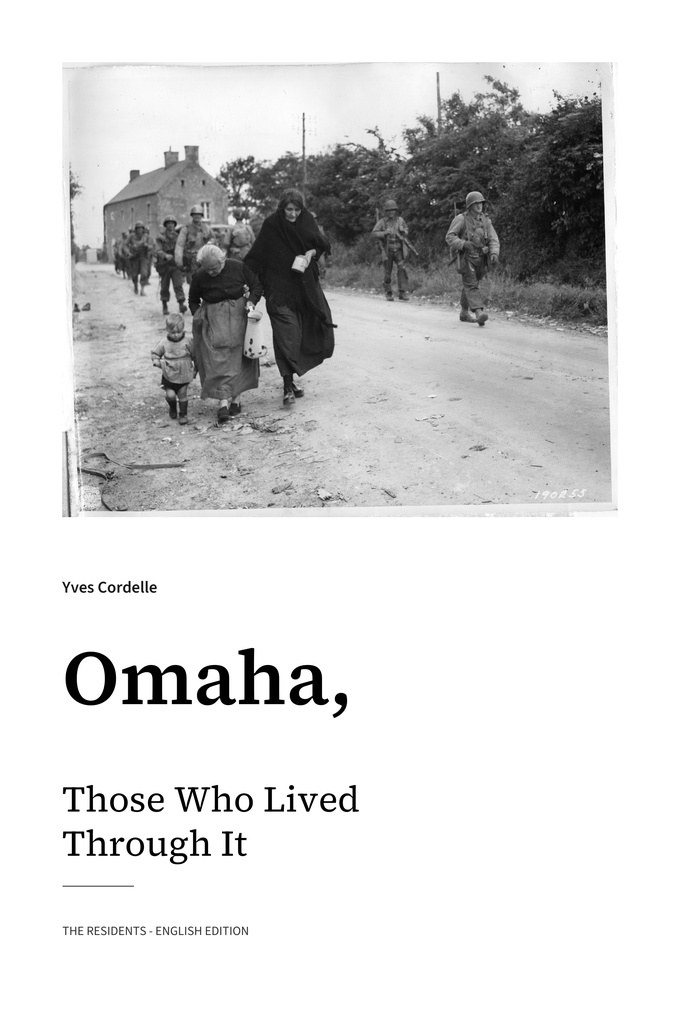
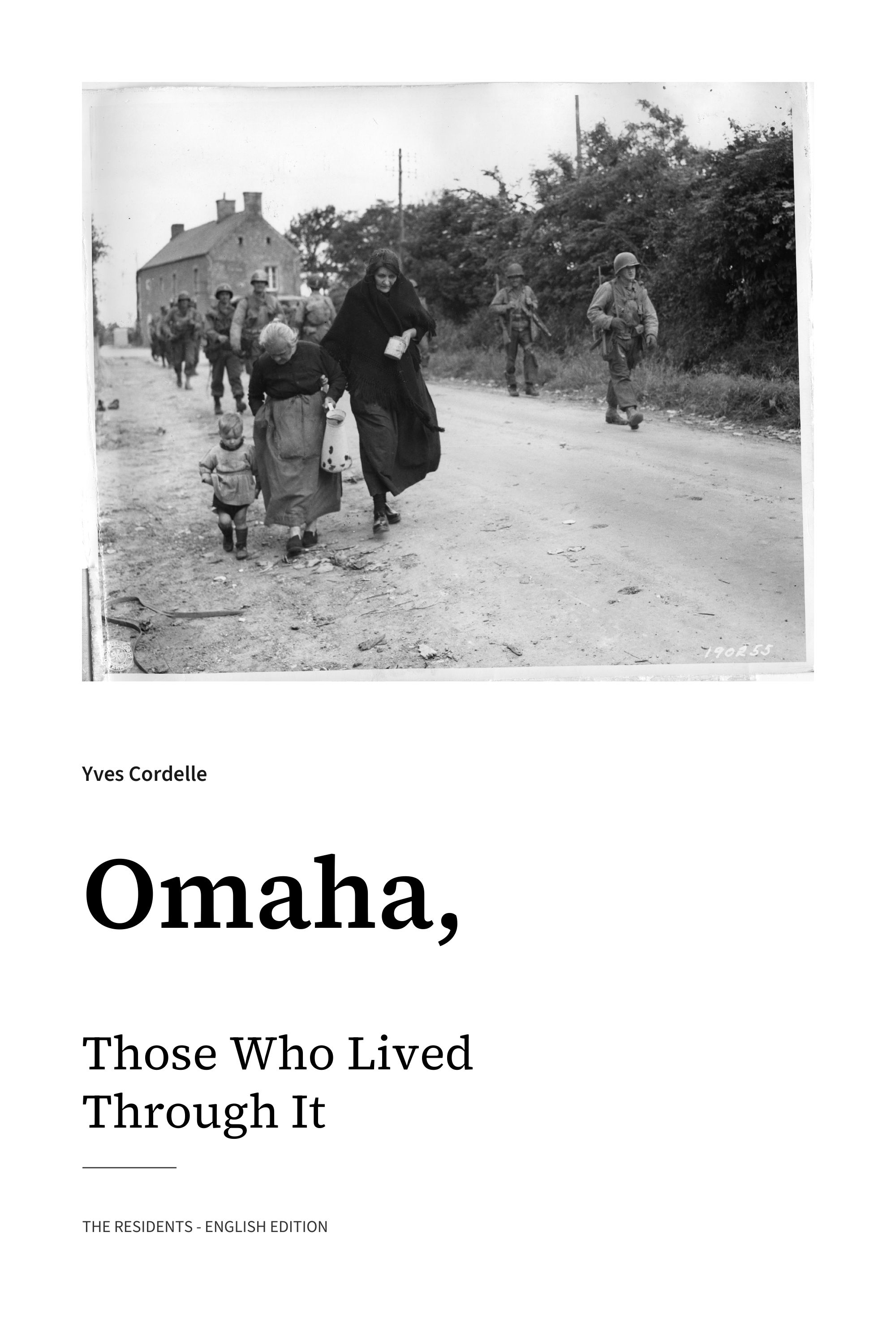
Cover photograph: NARA, 111-SC-190255, Lovella, June 7, 1944. The scene is in the Omaha sector; the original caption does not name the village.
To the Reader
Omaha: Those Who Lived Through It
Yves Cordelle
The accounts gathered here follow residents, soldiers, and sailors. They move from the sea to the houses, from the beach to the lanes on the plateau, then to the lives that continued after the fighting.
This edition brings together texts and documents collected by Yves Cordelle. Connecting passages were written for the book. Witnesses' words remain attributed; Yves's first-person passages are based on his surviving formulations.
Uncertain dates, differences between accounts, and incomplete identifications remain indicated. The notes lead back to documents in the archive.
Images and Places
Photographs retain their framing and their own dates. The maps use two military sheets from 1944 preserved in the archive. Beach exits, witnesses, and stages of journeys have been added for this edition.
Cover photograph: NARA, 111-SC-190255, Lovella, June 7, 1944. The scene is in the Omaha sector; the original caption does not name the village.
English documentary edition - November 22, 2026
About This English Edition
This edition translates the French documentary narrative into American English. Quoted passages are translated from the French edition, including where the underlying testimony was originally in English; they are not presented as checked transcriptions of the original English wording.
Place names, beach-sector codes, vessel numbers, source identifiers, credits, and uncertainties are retained. Source titles are translated for the reader; the archive's identifiers and linked records provide the reference points.
Historical texts and images retain their respective rights and credits. The archive does not assign a general license to third-party photographs. Image-specific rights and reservations appear in the illustration credits.
The following maps provide geographical reference points. Sources, notes, and image credits are collected at the end of the book.
D1 Vierville - D3 Les Moulins - E1 Le Ruquet
E3 Colleville - F1 Cabourg
1-3 Vierville: Coliboeuf, Hardelay, and Houyvet (detail on the next page).
4 Slaughter: landing sector. 5 Shepard: LCI 92 sector.
6 Gockel: the WN 62 sector, west of the E3 valley.
June 7 Coliboeuf and his two sons: station - D1 - shore - Le Ruquet, then back along the beach.
Solid line: documented stages, indicative route. Dotted ellipse: approximate sector.
1 Station: Louis Coliboeuf and his two sons. 2 Michel Hardelay's lodging in the village. 3 School: Victorine Houyvet.
4 Slaughter and 5 Shepard / LCI 92: approximate sectors on June 6.
7 Walker: up the cliff, then toward Vierville on June 6. Long dashes show a direction; the exact path is unknown.
8 Rockwell: craft bound for Dog Green / Dog White. This marker does not locate a ship.
June 7 Coliboeuf: station, quarry (not located here), D1, then shore. Hardelay: lodging - school - return (short dots).
Village points indicate neighborhoods to roughly 80-100 meters. Hardelay's lodging is distinct from the seafront villa.
Night at Sea and in the Houses
On Sunday, June 4, Michel Hardelay began digging a shelter in his garden. The trench was intended for his mother, their housekeeper, and himself. He planned steps at each end, turf along the sides, and enough depth to protect them. The work was still unfinished when the night of June 5-6 arrived.
Hardelay feared, above all, the bombing that might precede an assault. He had heard the advice broadcast on British radio. He knew neither the date nor the location of the operations.
In the accounts collected here, ordinary tasks still filled the days before June 6. People worked, prepared meals, and wrote to their families. Servicemen stood watch and checked their equipment. Their knowledge of what lay ahead varied greatly. A crew waited for sailing orders; a family recognized an unfamiliar sound; a German soldier wondered whether this was another practice alert. To follow this night, we must leave each person with only what they could have known.[1]
To follow this night, we must leave each person with only what they could have known.
From the narrativeMichel Hardelay's Garden
In Vierville, Sunday had been a day of First Communions. Twelve-year-old Raymonde Hue had received a blue bicycle. Relatives had obtained permission to enter the restricted coastal zone for the ceremonies. For once, the meals included white bread and a few treats. The following day, people finished the leftovers.
Hardelay chose to spend part of that Sunday on his shelter. His neighbor, Mayor Fernand Leterrier, came up to the low wall and asked what he was doing. In Hardelay's recollection, the mayor was unconvinced that a landing might take place here. His proposal to extend the trench to accommodate two more people came to nothing. Hardelay carried on alone, completing only a small part of the work.
That evening, the vegetables still needed watering. Each property had its own well and pump; water had to be carried. Hardelay went to the henhouse and collected the eggs. These chores did not put the war on hold. They took place in a village where requisitions determined part of the working day and where beach defenses had already led to houses being destroyed.
His own house was among them. The previous week, he had worked with the team assigned to demolish his villa. He tried to limit the damage to a recent concrete addition that was difficult to destroy with the equipment available. On Monday, he went down with a rope for moving beams. He noticed that guards were absent from places where he usually saw them. He also noted an unusual interruption in the requisition orders arriving at the town hall.
These observations became significant in his account. At the time, however, they gave him no explanation. Personal messages were multiplying on the radio. Hardelay listened without knowing what they meant. All he gathered was that major operations seemed close. Before going to bed, he still intended to finish his shelter the next day.[1]
Provenance and details
Rights to be verified
The precise date comes from the archive's captions and the series context; the record's date field gives only 1943.
Aboard LCI 92
Across the English Channel, not every crew had the same information. Aboard LCI 92, an infantry landing craft manned by the U.S. Coast Guard, Seth Shepard watched the final preparations. He was a combat photographer. The account he would leave was dated June 25, 1944, at Plymouth, less than three weeks after the events.
In the days before departure, leave had been canceled. The men could no longer leave the ship freely or speak to people on the quays. The commanding officer worked on his charts and instructions. Orders required the ship to be ready to sail at short notice. Shepard noticed that, on the last evening before the troops arrived, more sailors were writing at the large table in the crew's quarters. Some sent money home.
The embarked soldiers soon occupied the decks and available bunks. Shepard remembered men reading, playing cards, cleaning their weapons, or sleeping. A sailor met a soldier from his hometown; their conversation took them back to Texas. These were still exchanges between men brought together for a crossing whose importance they now understood, without knowing what awaited them at the foot of the ramps.
Departure interrupted the evening meal. The ship joined the other vessels. As she headed out to sea, the familiar landmarks of the harbor receded. Watches organized the night aboard. The ship's motion, the wind, and the cold entered Shepard's account long before the gunfire. He described a gray sea and men trying to rest whenever their duties allowed.
Before falling asleep, he watched a lamp swinging in front of the bunks. This detail stayed in his memory alongside the orders and the ship's movements. He then slept until the call to turn out at three. His task was clear: he was to take photographs. His camera and film would go with him when he returned to the bridge.[2]
The Coliboeuf Family's Station House
In Vierville, Louis and Jeanne Coliboeuf lived with four of their children in the former railway station. The little train no longer ran. The building still had its four rooms and canopy, but it also contained a space that would become vital: a cellar beneath part of the house.
Louis held several jobs in the village. He was a road worker, rural constable, and bell ringer. Jeanne looked after, among other things, parcels and tickets for the few travelers. She was also in demand as a cook. Before the war, she had worked at the chateau in Vierville; people still called on her for weddings, baptisms, and First Communions.
That night, she was finishing just such a meal at a farm. After making use of leftovers from the previous meals, she cleaned and put away her utensils. According to the surviving account, she left at about half past three. Indoors, conversation and singing had masked some of the sounds outside. Once she stepped out, she heard something different.
She knew the sound of passing aircraft and distant rumbling. What caught her attention was a new, intermittent pounding. She returned to the station and woke her husband instead of going to bed. Louis went outside in turn. The account attributes this conclusion to him: "Those are ships, and there are a lot of them."
That did not yet tell them where the ships were going. Louis woke the children. They had to dress and pack small suitcases with the essentials. At that moment, the landings were a possibility whose signs they were trying to read from their home. They needed to be ready to leave or take shelter before knowing which decision would be right.[3]
Provenance and details
Rights to be verified
The archive's captions variously give 1947, circa 1947, or circa 1948. The portrait must not be dated June 1944, and individual people must not be identified without further evidence.
The Bunks at WN 62
Farther east, above the beach at Colleville, Franz Gockel belonged to the garrison of WN 62. The designation referred to a German strongpoint with firing positions, shelters, and connecting routes. Gockel was eighteen. He had been on this coast for several months, and his post was part of the occupying army's defenses.
He described the work before the landings: digging, reinforcing positions, and trying to connect the shelters to the weapons. Not everything was finished. A stretch of trench still had to be opened. The ground was hard; progress was measured in a few meters. Watches followed one another while the work continued.
Inside the shelter, the evening returned to its familiar routines. Men reread news from home or wrote letters. A few played cards. An old gramophone played the same records. There had been no electric light for weeks; candles and oil lamps dimly lit the stacked bunks.
Gockel came off watch and wanted to sleep before his next turn. The men kept their uniforms on and their boots within reach. He and a comrade hoped, above all, not to be woken for another practice alert. There had been frequent drills over the preceding days. He took off his coat and boots and fell asleep.
In his account, the alarm woke him at about one in the morning. Some men were slow to get up, convinced it was another drill. The noncommissioned officer Förster intervened and got them outside. The weapons were loaded. Reports reaching the post mentioned parachute drops in the Cotentin and approaching ships. Yet the sea in front of WN 62 still appeared empty.
The wait continued in the cold. Gockel remembered their light work fatigues, which they had kept on because the earthworks were supposed to resume the next day. The cook handed out mulled wine. From his position, the young soldier could prepare his weapon and wait for whatever information reached him. He could not yet see the fleet he had been told about.[4]
The North-Facing Window
Michel Hardelay and his mother had spent part of the evening in the garden. Aircraft noise and explosions had joined the usual sounds of the night. In his recollection, German searchlights picked out small white specks drifting slowly down. He would identify them as leaflets urging the population to move away from the coast.
Before going to his room, he looked through a north-facing window. The sea could just be distinguished from the surrounding darkness. A sentry stood motionless on the ridge. Hardelay could still hear a distant noise. He lay down without fully undressing and fell asleep.
An aircraft, followed by explosions, woke him. He placed this episode at about three. Bombs had fallen near the cliff. He dressed fully, warned his mother and their housekeeper, and asked them to get ready. He then returned to look out at regular intervals. The unfinished shelter was close by in the garden.
The times remain uncertain. The annotations in the file do not allow the bombing raids Hardelay remembered to be identified with confidence.[5]
Before the Ships Came into View
At three, according to his own account, Shepard got up aboard LCI 92. He took his equipment with him. In the distance, he saw flashes. The outlines of the other ships gradually emerged. The waiting took place on the water, among vessels adjusting their movements before turning toward land.
Shepard noticed the wind in the rigging and the changes in the sky. He would remember a brief shift from gray to pink and red before cooler colors returned.
At the Coliboeuf home, the children were dressed and the suitcases were being packed. Hardelay returned to his window. Gockel stayed beside his weapon. The times given by these witnesses do not all fit together. Their common ground is simpler: as daylight spread, sounds could begin to be matched to visible shapes.
For many of those approaching, the coast was still only a direction to follow. For those living on it or defending it, the sea had not yet revealed the full scale of what was coming. The night ended with this difference in knowledge. The ships would appear; each person would watch from where they stood.[6]
The First Approaches
At dawn, the witnesses began to make out what they had mostly heard until then. Residents saw ships from the high ground or through the opening of a valley. Soldiers approaching by sea searched for landmarks learned in training. In the German positions, men gradually recognized a fleet whose numbers no longer resembled the usual movements offshore.
These discoveries did not happen at the same time. The vessels followed different routes and had different missions. Rockwell's tanks were due to arrive at about six thirty; Slaughter's landing craft belonged to another wave; Shepard's LCI 92 would approach later still. Between the first sight of the coast and arrival at the sand, the situation could change. Each crossing must be followed to its own stretch of shore.[7]
Each crossing must be followed to its own stretch of shore.
From the narrativeThe Sea Between the Transports and the Beach
Offshore, the men transferred from the large transports to the small craft. Some boarded before the davits lowered them into the water. Others climbed down nets hung over the ships' sides. The methods differed from vessel to vessel. In every case, the motion of the boats made the maneuver difficult.
They then had to assemble. The landing craft circled while waiting for the other members of their group, then headed for the line of departure. The plans had assigned each unit a stretch of beach and an inland objective. On the water, the distances between craft, the delays, and the current were already beginning to alter that order.
The Omaha coastline did not offer the same possibilities everywhere. To the west lay the Vierville exits; farther east were those at Saint-Laurent, Le Ruquet, and Colleville. Between them were slopes, cliffs, and defended positions. Recognizing a valley or a group of houses was supposed to help the men find their sector. But first they had to see the landmarks and correct their drift during the approach.
The current carried craft eastward. Smoke and haze made recognition harder. A formation might break up, a craft might follow a misleading landmark, or it might land some distance from its objective. A soldier packed in among the others had little opportunity to check the course through the poor visibility. The helmsman and control vessels bore a responsibility the passengers could scarcely share.[7]
The Tanks Stay Aboard
Lieutenant Dean Rockwell commanded a group of landing craft carrying the amphibious tanks of the 743rd Tank Battalion. These tanks had flotation screens and propellers intended to let them reach land after being launched offshore. The plan assumed that sea conditions would permit this crossing.
Rockwell saw a sea that, in his judgment, made the plan unworkable. In his July 14 report, he stated that he had contacted Captain Elder over the tank radio at 5:05 a.m. The two men agreed to keep the tanks aboard and carry them to the beach. The report of LCT 590 also recorded the order to continue toward shore with the tanks.
This decision changed the crews' task. Their craft would not stop at the planned launching point. It had to go farther in, beach close enough to land, and let the vehicles drive down its ramp. The possibility of supporting the infantry therefore still depended on navigating a vessel and bringing it to the right place.
The surviving records do not all give the same time for the final turn toward the beach. Rockwell's report placed it at 5:40 a.m.; that of LCT 590 at 5:45. David Howarth's account gave another time. These indications need not be reduced to a single minute to understand the decision. The documents agree on the essential point: the tanks were kept aboard, and the landing craft were to carry them ashore.[8]
Provenance and details
Rights to be verified
The available caption gives no date, location, or vessel number. Its inclusion in the LCT 590 report does not, by itself, identify this craft.
A Coastline Hard to Recognize
In Six juin à l'aube, David Howarth described this final stage of Rockwell's approach.
In that account, smoke hid much of the coast. The tops of the cliffs remained visible, but the details needed to recognize the landing place disappeared. A break in the smoke briefly revealed an exit and some villas. Rockwell realized that he had drifted east and corrected his course.
On the approach, a beach might look quiet and still be defended. Ruined houses, smoking grass, or the absence of visible men did not prove that the weapons had been destroyed. From a ship, an observer could see the surface. The shelters and firing positions did not necessarily reveal whether they were occupied.
Above the Hardelay villa, strongpoint WN 70 was still under construction. Whether a 75 mm gun was actually installed there remains uncertain. I have no photograph of this hypothetical gun. Nor does any testimony from the soldiers who passed that way settle the question in the documents collected here.[9]
Slaughter in the Small Landing Craft
Sergeant J. R. Slaughter belonged to Company D, 116th Infantry Regiment. From the Empire Javelin, he had boarded a British landing craft. The men took the places assigned to them during training. Once lowered into the water, they immediately found themselves in a sea that battered the craft and washed over it.
The pumps could not keep up. The soldiers used their helmets to bail. Slaughter tried to shelter inside a protective gas cover; he felt stifled and seasick. He described the cold and the water soaking through his clothes. The engine drowned out some of the other sounds and made conversation difficult.
He first remembered the sense of security the armada gave him. Aircraft flew above the craft; ships fired toward land. The massed power seemed certain to crush the defenses. This was an impression he recalled afterward, knowing what had followed. During the approach, he also wanted, very simply, to get out of the craft in which he felt so ill.
Men were still floating after another craft had sunk. According to his account, his own picked up three of them. With no room left, the others stayed in the water. Slaughter remembered neither their unit nor how long they had been waiting. The rescue interrupted the run toward the beach; later, he would draw from it reflections on the chance that had kept him alive.
The coast came closer. Shells fell around the craft and threw up columns of water. Slaughter himself was unsure of his arrival time, which he placed at about seven. Other craft had already landed. His crossing therefore does not describe the shore as the very first waves found it.
In the dialogue he recalled, the sailor wanted to lower the ramp while the craft was still far from shore. Sergeant Willard Norfleet insisted that he go farther in. The men's loads made any distance through the water especially dangerous. Despite orders, Slaughter raised his head and saw another craft hit by gunfire. His own desire had narrowed to a few words: "What I wanted was dry land."[10]
From WN 62
At Colleville, Gockel first took the shadows offshore for German patrols. Their number and size forced him to abandon that explanation. The silhouettes multiplied. The sea he had watched during his sentry duty now held a movement he could no longer mistake for the ordinary.
At his weapon, he checked the ammunition belts. His position had several openings facing the sea. The bombardment drove him to shelter beneath the machine-gun mounting. He remembered dust in his eyes and nose, sand between his teeth, and the shocks of the explosions.
In his memory, the ships gradually became clearer. He wrote that they had expected a landing at high tide and that the expanse of exposed sand surprised him.
Gockel also wrote that they had to wait until the craft were close enough for the weapons at their disposal. This was the waiting of a soldier tasked with resisting the landings. The men coming toward him watched the same shore from the opposite direction, using different landmarks. Between these positions and the craft, the beach still had to be crossed.[11]
The Residents See the Fleet
In Vierville, Hardelay was still looking out from his house. In his recollection, the haze broke and revealed an immense number of boats. He called his mother and neighbors. They moved to a place with a view of the sea and stood watching for a while.
Hardelay placed this discovery at sunrise. Yet the sequence remains uncertain: the first naval gunfire had begun before then.
The residents returned to their houses. Hardelay's mother gathered her jewelry and money and headed for the shelter. He joined her with a chair. Before going down the steps, he laid bundles of brushwood across the small trench. The structure he had hoped to finish had to serve as it was.
At the old station, Louis Coliboeuf had also made out ships through the valley opening. He first gathered his family in a still-shallow trench near the building. Fragments of stone fell into their trench after shells struck the chateau. They decided to move into the cellar. The dog and the pig remained outside.[12]
LCI 92's Later Approach
Aboard LCI 92, Shepard had watched daylight overtake the night, his camera within reach. At 5:50 a.m., according to his account, his flotilla's vessels formed two columns and headed for land. The coast was still veiled. His ship would not land with the first waves.
At about eight, as his vessel approached the beach, the battle was already underway. Shepard could now recognize damaged landing craft, men seeking cover, and houses destroyed or burning. He saw LCI 91 ablaze ahead of their course. What he discovered was very different from the quiet appearance described in the account of Rockwell's earlier arrival.
The ramps had been prepared. Shepard described the men's increasing attention as details came into view. He himself had to find a place to work. He could make out the wooden and steel obstacles and nearby explosions.
He positioned himself to port, near the signal lamp, and braced himself with his camera. His account was that of a man with a job to do as part of the crew. He already knew that the beach remained defended. He did not yet know what would happen to his ship.
In the small landing craft, the tank landing craft, and the infantry landing ships, the approaches had followed one another without being alike. The first arrivals had changed the shore the later ones would see. The residents had taken shelter; the defenders had manned their positions. We must now return to the first waves and follow the men as the ramps went down.[13]
Landing and Surviving
Company A off Vierville
Jimmy Green's LCA came to rest on the bottom. The ramp went down, and Captain Taylor Fellers moved forward with the men of Company A, 116th Infantry Regiment. Green had carried them from the Empire Javelin. He now had to let them continue ashore, then return to survivors from another craft in his flotilla. From his place as a sailor, he was still watching a landing that retained something of the training exercises.
The soldiers filed out, burdened with weapons and equipment. The opening was narrow, and clearing the craft seemed slow to Green. He saw Fellers reach the sand and begin gathering his men. Mortar rounds came closer. The sailor radioed his arrival, then prepared to leave. He would state explicitly that he had not seen the captain die.
Green's recollection did not describe the same first seconds as other accounts from Dog Green. He placed the machine-gun fire after his passengers had disembarked. The overview of the first wave, by contrast, brought together memories of bullets striking the ramps and the water in front of the men landing. Not all craft touched down at the same moment or in exactly the same place. An entire company cannot be given the view Green had from a single boat.
An entire company cannot be given the view Green had from a single boat.
From the narrativeFor the infantrymen, the crossing often began in water much deeper than expected. Some craft had struck a sandbar short of the shore. Dozens of meters remained to be covered through the channels and then over the exposed beach. Wet clothing weighed heavily; equipment slowed men already weakened by the crossing. Some went over the sides of the craft or briefly submerged to escape the gunfire.
Company A suffered very heavy casualties and could not carry out the planned assault toward the Vierville exit. Some survivors stayed close to the water and moved up with it. Others tried to reach the seawall. Meanwhile, Green saw signals from sailors whose craft had been destroyed after carrying Rangers. He went back to pick them up, including a wounded man supported by his comrades, then returned for the men still at sea after LCA 911 had sunk. The transport mission continued as rescue work, in both directions.[14]
Provenance and details
NARA Use Restriction: Unrestricted
The original caption does not name the men or locate the scene at Vierville. The photograph should not be attributed to Company A, 116th Infantry.
Slaughter's Crossing
When Slaughter left his craft, other men were already in the water. His Company D of the 116th carried heavy weapons and their accessories. The sergeant, who until then had wanted above all to end his seasickness, had to choose his moment to jump. The ramp rose and fell with the waves. The men went out two at a time. He remembered hesitating, aware that he was holding up those behind him.
Once in the water, he inflated his life belt and helped Ernest McCanless, who had kept a box of machine-gun ammunition. Bodies floated around them. Some men tried to avoid notice by moving with the waves. Slaughter thought he recognized Richard Gomez among the dead. He later learned that Gomez had survived. Even a few meters away, with a name in mind and a face he thought he knew, he could be mistaken.
At first, he stayed near the obstacles. A large timber seemed to offer cover, until he noticed the mine attached to it. He moved elsewhere. Nearby, a man tried to cross the beach and fell; a medic who went to help was hit in turn. Slaughter would remember the two wounded men lying close together, unable to help them.
The tide was narrowing the available space. Slaughter no longer knew how long he had spent in the water. He placed his landing at about seven and his move toward the upper beach roughly an hour later. He asked Walfred Williams to follow him. Williams still carried the machine-gun tripod. Sal Augeri and McCanless joined them. They had about a hundred meters to cover, bent low, with water-filled shoes and the heavy fabric of their uniforms clinging to their bodies.
Slaughter stumbled in a pool. As he regained his balance, he accidentally squeezed his rifle's trigger and almost wounded himself. He kept going until he reached the small embankment. There he turned to look back at the ships. At last he could take off his jacket, spread out his raincoat, and clean his weapon. He found bullet holes in his clothes that he had not noticed during the run.
At the foot of the slope, his group met scattered soldiers. A team from Company H had an incomplete weapon; Williams had the tripod they lacked. By pooling what they had kept, the men set up a machine gun. Their rounds ricocheted off a concrete position. After a few bursts, the weapon jammed. They withdrew before the return fire. Slaughter would claim no decisive result from this firing: for them, it had chiefly been their first chance to shoot back.[15]
Those Who Could Go No Farther
Lieutenant Bob Edlin of Company A, 2nd Ranger Battalion, also arrived before a stretch of water his craft could cross no farther. It had grounded on a sandbar. The men climbed down at the sides of the ramp to avoid being crushed by its movement. Edlin saw soldiers of the 116th floating with their packs; others lay behind the obstacles. He continued toward the low seafront wall.
He tried to get the men he encountered moving again. Their stillness did not always reveal its cause. About twenty meters from the wall, a bullet struck his right leg. His rifle fell ahead of him. He crawled to retrieve it, and when he tried to rise, he was hit in the other leg. His journey shrank to the distance he could still gain on his hands and knees.
A little farther on, he made out Butch Bladorn, a Ranger from Wisconsin. He told him to get up, then moved closer to make him go. Only then did he discover the wound holding him to the ground. Edlin had first mistaken physical incapacity for a refusal to advance. He then believed Bladorn would not survive. Once again, what followed would contradict what a man could conclude on the beach: Bladorn would return home and become a farmer.
Edlin lost consciousness, then saw a sergeant sheltering against the wall. The sergeant crawled out to him and dragged him into the protection of the stones. A medic intervened. The lieutenant could still give instructions to the Rangers gathered near him and urge them onward. He heard calls and gunfire higher up, unable to follow those leaving their shelter.
He then gathered the wounded and had them keep their weapons within reach. Training had taught him to expect a counterattack. It seemed possible, although he did not know what the other units had achieved. Looking out to sea, he eventually even believed that the landings had been abandoned. An officer who introduced himself as a colonel of the 29th Division brought more reassuring news. Edlin had remained on the beach while the battle changed around him. His lack of information had taken the shape of a defeat he believed already complete.[16]
Provenance and details
NARA Use Restriction: Unrestricted
The medic's unit is given in the original caption. None of the men is named, and the precise sector is not stated.
Tanks and Gaps in the Obstacles
The tanks Rockwell had kept on their landing craft arrived off Vierville with their crews inside. The decision to carry them to the beach had spared them a long independent crossing. It did not guarantee the final passage. A tank might still encounter excessive depth as it left the ramp. Another might be hit before reaching the sand. The crews had to begin fighting as soon as they left the vessel carrying them.
On the beach, some Shermans fired while still partly in the water. Others moved among the obstacles or stopped with a damaged track. They searched for embrasures and weapons whose fire the infantry were enduring without always being able to locate them. The tanks' firing drew the defenders' attention in return. An armored vehicle temporarily sheltering men could become a target that made it dangerous to stay nearby.
At the same time, engineers and sailors had a task that forced them to linger where the infantry sought to pass as quickly as possible. The Special Engineer Task Force teams had to open lanes through the obstacles. Army engineers and naval demolition men carried explosives, with reserves loaded on inflatable boats. They had to attach the charges, get the men clear, blow the obstacles, and mark the passage for the vessels that would follow.
Gap Team 1 had drifted to the boundary between Dog White and Dog Red. It began with the tall metal obstacles that would be submerged first. The men then moved on to stakes, ramps, and hedgehogs. Mines fixed to the wood required particular care: destroying a support without dealing with its mine might leave a newly floating timber drifting with the mine attached.
Infantrymen arrived and sheltered against the obstacles the team was preparing to demolish. The two missions obstructed each other in the same place. The soldiers had to be moved before the charges were fired. They helped carry wounded engineers out of the area. The lane was eventually opened, but the archive's accounts disagree about how effectively it was marked. For approaching vessels, a passage they could not distinguish remained difficult to use.
Elsewhere, teams were late, scattered, or without their reserve supplies. Water gradually covered the work site. The tankdozers intended to move obstacles failed to reach the groups they were meant to support. The survivors made for the embankment, settled the wounded as best they could, and had to wait for the sea to give back some ground. The obstacles still standing thus continued to determine how men arrived long after the first wave.[17]
Off Les Moulins and Le Ruquet
At Saint-Laurent, opposite Les Moulins, German positions also dominated the arrivals. The 116th's companies had not found their assigned sectors. Part of Company F had landed farther west; men of Company G had come this way after missing Dog White. Company E, expected off Saint-Laurent, had largely ended up toward Colleville. The neighbors planned on the maps were no longer those the men encountered on the sand.
Company F's survivors gathered against the shingle bank, in front of barbed wire and positions still in action. Their captain, Callahan, had no radio. He was badly wounded while trying to point out targets to a tank. Having an armored vehicle nearby was therefore not enough to secure the support expected: someone still had to show it where the fire was coming from and reach it without being hit.
The shingle offered protection against direct fire, but mortar rounds could still reach it. Individual weapons had taken in water and sand. They had to be cleaned in this narrow space, among the arriving men. Groups trying to regain their sector along the beach split up at groynes and other shelters. A company could lose its order without every man having been hit.
Farther east, toward Le Ruquet, conditions changed over short distances. A few craft had landed between strongpoints, far enough from their main weapons. Ruins provided cover. Engineer teams had cleared some obstacles without achieving all the clearly marked passages expected. This stretch of beach would receive increasing numbers of arrivals. Its first morning was not uniform, however: some vessels got through; others were hit and had to withdraw.
The men of Company C, 116th Infantry, interviewed by Lieutenant Shea had landed very far from their Vierville objective. One of their craft had capsized, losing its assault equipment. The survivors reached a small timber retaining wall, where Rangers, engineers, and other infantrymen joined them. Their recollections trace the loss of equipment and the gathering at this shelter. They do not establish a certain time for every movement: a watch mentioned after the battle is not enough to put all the arrivals back in order.[18]
The Beach Below WN 62
Off Colleville, men of the 16th and 116th Infantry Regiments found themselves mixed together on Fox Green. Some had been carried far east of their sectors. Crews of amphibious tanks had disappeared during the crossing; too few tanks had reached land to provide the planned support everywhere. Strongpoints WN 61 and WN 62 retained some of their weapons and brought fire onto the groups crossing the beach.
At WN 62, Franz Gockel saw men leave their craft and seek the embankment. He had endured the bombardment before returning to his machine gun. He reported firing at landing boats, then having to remove a dirty ammunition belt. As he put it back, his weapon was struck by projectiles. The sand that jammed rifles on the beach could also interrupt a machine gun's fire inside a strongpoint.
Gockel described neighboring weapons still firing and crewmen being hit. One gun was put out of action by rounds entering its opening. Others continued. His testimony follows the activity of a single post, with interruptions, changes of weapon, and casualties. It did not give him complete knowledge of events at the other strongpoints, or a way to count the victims of the firing he observed.
For the Americans who reached the shingle, the immediate priority was to escape the weapons sweeping the sand. But mortar explosions reached this bank and hurled stones along with shell fragments. The beach's first cover was not a lasting shelter. New arrivals swelled the groups already lying there, whose leaders searched for their men and for weapons that could still be used.
The sea rose in front of Gockel. He saw the exposed crossing shorten and the craft come closer. The water also carried dead and wounded men and debris to the shore. In his account, the battle at times seemed contained in front of his own post. Elsewhere, however, men were reaching places less directly exposed to fire. The beach's condition could no longer be read through a single embrasure: some groups remained pinned below Colleville while, a short distance away, others already had a chance to move on.[19]
The Report of LCI 91
LCI 91 carried 201 men in addition to her crew. She was bringing personnel from the 116th's headquarters, engineers, and men of the naval beach battalion. Her commanding officer, Arend Vyn, wrote his report on June 10. At that point, he did not yet have an exact count of the survivors. He could, however, describe the maneuvers that had led to the vessel's loss.
Approaching Dog White, Vyn could not find the marked channel he expected. A small opening between the obstacles appeared blocked by a sunken amphibious vehicle. He beached his ship at about 7:40 a.m. and had a line taken ashore between the mine-topped stakes. Soldiers went down both ramps under fire. The line marked a path through water in which walking was difficult.
Disembarkation took time, and the tide lifted the vessel. Vyn had to move forward to keep her grounded, then back off when the stakes prevented any further advance. A mine exploded near the port bow. The ship could still maneuver, but about sixty soldiers remained aboard. A signal requested help from small craft. None came. The commanding officer tried to beach again, a little farther west.
Some of the last passengers were still disembarking when a projectile hit amidships. Vyn thought it was an 88 mm shell; he did not present the identification as certain. The fuel tanks caught fire. Water pressure was insufficient to control the blaze. He ordered the ship abandoned. Men went over the sides toward the beach; a small group was picked up seaward, and two wounded soldiers were taken ashore on a raft.
A soldier whose name Vyn did not know helped evacuate passengers and search for anyone left inside. Accessible compartments were checked. Secret communications publications were taken out to sea; operational orders were destroyed. On the shore, sailors and soldiers now found themselves among the men they had only been meant to land or support. Their ship remained behind them, burning.[20]
LCI 92's Men on the Shingle
On LCI 92, Seth Shepard was still positioned with his camera near the signal lamp when the first explosion knocked him down. A second shock followed. Forward, men had been burned or thrown from their stations. The damaged ramps could no longer be lowered. Fire, scattered boxes, and equipment blocked movement. The photographer, who had been waiting to capture the arrival, first had to find a way through his own ship.
In his text, he preserved the names of the sailors he had seen and the actions he could piece together from their accounts. Raymond Macht used his hands to put out the fire in Martin Masariu's hair. Aft, the corpsmen Maleska and Hursey treated burns. In the engine room, the men stayed at their controls as smoke reached them; with the telephones out of action, they no longer knew exactly what was happening above. Eventually, they had to get out to breathe.
Shepard was still trying to hose down the forward part of the ship. The stream had become too weak to stop the fire. Screened by the bulkheads and occupied with his hose, he was slow to realize that the crew were abandoning ship. He went below to collect photographic equipment, then joined those entering the water. His life jacket supported him; his shoes and helmet hindered him. He reached the shingle exhausted.
The ship had not trapped everyone the crew believed missing. A sailor thrown into the sea, Lester Phillips, would be picked up by a landing craft. Shepard and his comrades would not learn what had happened to him for several days. That evening on the beach, they had to live with the absences they could see and the news they lacked. The crew list was not yet settled.
The survivors crawled to the retaining stakes. Wind chilled them in their soaked clothing. When the falling tide made the ship accessible, a few men returned for blankets and cans of soup. They then had to move away from the wreck, which was still drawing fire. They dug into the stones and earth to improve their protection. They watched reinforcements pass and heard the warships' salvos without being able to join the advance.
Others had kept their weapons and were already looking for a way forward. For the wounded, the sailors without a ship, and the men who had lost their units, landing continued as waiting. They were ashore but not yet clear of the battle. Above them, the slopes now offered some groups a way out that would have to be found, opened, and held. Behind them, the shingle remained occupied by those who could not follow.[21]
Leaving the Beach and Meeting the Residents
Ways Up the Slope
Captain Robert Walker had lost contact with the other men of his regiment after LCI 91 caught fire. He crossed the road and climbed alone. On the slope, he found a dead American infantryman, took his rifle and helmet, and continued toward the top. He wanted to reach Vierville, the 116th Infantry Regiment's assembly point.
A groan stopped him. A German soldier, wounded in the abdomen, asked for water. Walker's canteen was empty. The two men managed to understand each other in German: there was a spring a little higher up. Walker found it, filled his canteen, and went back down to the wounded man. He returned a second time to fill the man's cup before continuing. In the surviving account, this was the only living soldier he encountered during his climb. He did not know which groups were climbing elsewhere.
A few hundred meters away, infantrymen of Company C, 116th Infantry, were also looking for a way out. Their recollections were collected by Lieutenant Shea. Beyond the low wall, two rows of barbed wire separated the men from the foot of the heights. Bedell and two soldiers began opening a passage. Close by, without their immediately knowing it, another group was preparing a Bangalore torpedo.
The first attempt to detonate it failed. Lieutenant Schwartz went back to the charge and worked on it; this time the wire blew. The witnesses could not recall the name of the first man through the opening. They remembered that he was hit and called for help. Others followed him. Two separate paths met in shallow trenches, and a column formed at the foot of the slope.
The men did not run uphill. They moved cautiously, watching where they placed their feet. Mines were a threat they could not assess as a whole. Folds in the ground and scrub hid them from the defenders in places. A slope that had seemed entirely exposed to fire when seen from the shingle therefore also contained cover. That could only be discovered by entering it.
Infantrymen from several companies and a few Rangers mixed in this column. Their leaders had no continuous view of the beach. Cota intervened with groups he could reach, got them moving, and sometimes took the lead himself. Other small groups had already left without his seeing them. The route to the plateau emerged from these neighboring initiatives, often unaware of one another.[22]
Beyond the Ridge
Bedell's first men emerged near low pine trees that would become a landmark in their recollections. They saw no troops ahead and believed they were the first to arrive. That impression tells us what they could see; it cannot establish the order of all the climbs. At the same time, Rangers and scattered elements of the 116th were coming up by other paths.
Reaching the plateau did not end the gunfire. Machine guns stopped the column. Three Rangers went along a hedge and ditch to outflank a position. Later, two returned to say that the third had been killed. When firing ceased from that direction, the infantrymen resumed their advance inland. Reaching the top changed the direction of the fighting without yet giving them freedom to move.
Bedell was looking for the road to Saint-Laurent. In fact, he reached the Hamel-au-Prêtre lane, which took him into Vierville. His men placed their arrival at the main crossroads at about ten. They did not see the small detachments that had crossed the village before them. They continued toward Grandcamp, as far as the last farms, before gunfire drove them into the ditches.
Attempts to outflank these defenders led into the fields to the south. There, hedges formed thick obstacles rooted in raised banks. A man lifting himself to see beyond might expose himself before spotting a gunman. Farm gateways were predictable places where the enemy could wait. The maps and photographs studied before departure had not given the soldiers the full measure of this terrain.
Two scouts tried to cross a field. One was killed; the other, mortally wounded, remained beyond reach until nightfall. Schwartz was killed in this fighting. Hawks and Bedell gave up trying to push farther and sought to rejoin their battalion. Without communications, they organized a defensive position. Nearby, the Rangers faced similar halts. Vic Miller ended the day west of Vierville, in a trench he dug for the night. The village lay behind them; the routes west remained closed.[23]
Michel Hardelay's Cigarette
In his garden, Michel Hardelay had seen none of these climbs. A very close explosion had thrown dust and debris above his shelter. He had felt a burning sensation in his little finger and pulled a still-hot shell fragment from the earth. The house remained standing. The walls between properties let him move with his head down.
Two Germans crossed the garden with their weapons and an ammunition box. Hardelay checked the gates they had used, then went back into the house. From upstairs, he made them out in a field toward the heights. Farther away, boats covered the sea. He could not see the beach, hidden by the ridge, and still did not know which troops would arrive.
A lull allowed him to reach the corner of Dumont's grocery store. In the street, a horse-drawn cart and its dead horses obstructed the way; rubble covered the other part of the road. When he turned toward the entrance to the Hamel-au-Prêtre lane, a soldier was already in front of him. The man offered him a cigarette in French.
The Ranger said he was of Canadian origin and that his parents lived in Nonancourt, in the Eure. Their conversation was brief. He moved on westward. Hardelay returned to show his mother the cigarette: "It is the Americans who are liberating us." He placed the encounter at about 9:20 a.m., after converting the time system he had used. His watch had stopped in the earlier explosion, so the estimate's precision remains limited.
The occupants of the street changed quickly. German prisoners were made to clear the dead horses. Two American soldiers asked for a drink. Hardelay offered cider but had to take a sip first to reassure them. The exchange required gestures, a few words, and the overcoming of a mistrust whose reasons the residents did not yet understand.
A neighbor brought the first news from other houses. Some families were unharmed; elsewhere there were wounded people. At the bakery, an employee and the baby she was carrying had been killed. The Americans' arrival did not, then, separate a morning of fear from a moment when everyone was safe. It allowed people to venture out a little, seek news, and discover what had happened just a few doors away.[24]
Provenance and details
Rights to be verified
A location view. The captions mention troops passing on June 6 but do not date the exposure; it must not be presented as a photograph of the fighting.
Soldiers at the House Doors
At the school, Victorine Houyvet saw an American appear in a damaged doorway. She was thirty-one and had spent the night without sleep. Startled, she raised her arms. According to her testimony, the man fired toward her; a sideways movement let her avoid the bullet, which passed toward the opposite window. She would suppose that he had taken her for a German. The soldier did not explain his action.
"It was not a pleasant first encounter," she said when recounting the scene. She joined her colleague, sheltered beneath the stairs, then reached the cellar of their neighbors, the postal workers. After what had happened, the two women did not dare present themselves to the newcomers. Through an opening, they saw prisoners being led into the schoolyard. Their view remained that of a cellar where their first concern was to stay safe.
Another American later came to ask them for a drink. He wanted them to taste it first, then gave them a bar of soap and chocolate. Houyvet placed these encounters on D-Day, but the times and detailed sequence in her account do not allow them to be fixed with certainty. The fear of the first exchange and the gestures of the next both belonged to her memory of liberation.
At the Dubois farm on the Grandcamp road, the family had taken shelter under a covered structure where Germans responsible for horses were also present. Soldiers had been billeted there by requisition. Their presence in the yard exposed the residents when the Americans arrived. Eleven-year-old Janine remembered her father going to tell the newcomers that his family was in the shelter. Her mother picked a rose and sent her to give it to a soldier.
A published version of this encounter described firing at the dovecote's openings, which had been mistaken for loopholes. Janine's account differs in several details, and she did not claim to know the time. Each version must be allowed its place. The gesture of the rose erased neither the nearby firing nor the uncertainty over how long the Americans would stay. At first, the family thought it was a commando operation.
Other residents remained out of contact for a long time. Madame Ygouf spent the day in a prepared ditch at the end of the garden with her family, the staff, and the small dogs. There were ten people. She had brought little, since she was still at home and expected to return to the house a few hours later. Nine-year-old Bernard Lecornichon lay sheltered by a wall. He would remember a heavy shell fragment falling near the fireplace, where he usually sat. A few streets apart, the same hours thus left very different memories.[25]
Vierville's Church Tower
By early afternoon, Americans held the center of Vierville. Those observing from the sea did not necessarily know it. Communications were too limited for a position occupied ashore to be recognized immediately as such offshore.
At 1:50 p.m., a visual signal from landing craft 538 asked the destroyer Harding to demolish a church tower believed to be an artillery observation post. The surviving exchange shows the uncertainty: was it Vierville or Colleville? Where had the information come from? The replies did not restore contact with the soldiers in the village. Permission was given to fire for one minute.
The Harding's report placed the opening of fire at 2:13 p.m. and recorded forty 127 mm shells. The tower collapsed. In Jeanne Coliboeuf's recollection, passed on by Hardelay, the bells could be heard falling from the station. Her husband Louis was the village bell ringer. Something that had belonged to their everyday work disappeared in the midst of the bombardment.
The documents do not confirm the German observation post that prompted the firing. The ship's report stated that every round hit its target; the signalman who transmitted the request would retain a different view. The church, rectory, and a neighboring house were hit. The file also mentions American soldiers struck by naval gunfire in the village, without allowing all these casualties to be tied securely to that particular minute.
Hardelay had placed the spire's disappearance in his account of the morning. Comparison with the naval report requires moving it to the afternoon. In recollections, a building absent after the battle may already be absent at the time of an earlier observation. Here, the correction changes the day's chronology: the tower fell when the first Americans had already been in Vierville for several hours.[26]
Getting the Vehicles Through
While the infantry crossed Vierville, vehicles still could not use the road up from the beach. The antitank wall blocked it at the foot of the valley. Men had climbed the slopes; trucks, guns, and clearing equipment needed a roadway. Opening the village and opening its approach from the sea were two separate operations.
Colonel Ploger of the 121st Engineer Battalion had landed far from the planned location, suffered losses, and then received a shell fragment in his leg. He gathered scattered engineers and searched for equipment. The first men had carried only limited charges. Explosives had to be recovered, neighboring units found, and the bulldozers that had finally landed brought forward.
Sergeant Dube arrived on Dog White after a delayed approach. His craft put him down almost on dry ground. He could not swim and understood his good fortune in not having to enter deep water with his equipment. The mission prepared in England had been to clear minefields near the village. In front of the wall, he received a new order: examine the obstacle and prepare its demolition.
With volunteers, he crossed the barbed wire and inspected the pedestrian opening in the chicane. Drivers brought up TNT. The engineers laid the charges, prepared detonators and wires, and checked that the men had moved away. Ploger credited Dube with a substantial part of this work and recalled the participation of several units, including the 147th Beach Engineer Battalion.
The file's overview placed the explosion at about three in the afternoon. Dube remembered it as later. Descriptions also differ over the amount of explosives and the reinforcement in the concrete. These discrepancies prevent a single arrangement from being reconstructed in every detail. They do not alter the result common to the accounts: an opening was made wide enough for the road.
The bulldozers immediately resumed work. The ditch had to be filled, fragments pushed aside, and collapsed buildings cleared from the route. Blowing the wall was therefore not enough to make the climb usable. A few meters from German positions now silenced, engineers turned a breach into a passage. Vehicles would be able to follow this route to infantrymen who had arrived several hours before them.[27]
Provenance and details
Rights to be verified
The date and description come from agreeing captions in the archive. The photograph shows the demolition's aftermath, not the explosion on June 6.
Le Ruquet Becomes a Route Inland
Farther east, the Le Ruquet valley took on an importance extending beyond its original sector. Groups landing between German strongpoints had also found routes onto the plateau. Lieutenant Spalding climbed with about twenty men of Company E, 16th Infantry Regiment. Company G, led by Captain Dawson, followed another path. Once at the top, they took separate directions: Spalding turned against strongpoint WN 64, Dawson toward Colleville.
Spalding approached the defenses from the rear. Germans emerged from their shelter with their wounded and surrendered. The position was neutralized during the morning. The other side of the valley still had to be overcome. Fresh troops, tanks, and naval gunfire contributed to that operation. The isolated detachments that had left the shingle could not, by themselves, open a road for the transports.
Wyman, the 1st Division's deputy commander, had come ashore after observing delays and obstacles to the landings from offshore. His messages called for combat troops and stressed the beach exits. The news reaching him remained fragmentary. He sought units already fighting on the plateau without being able to follow their movements exactly.
The 18th Infantry Regiment arrived in this sector. The 115th, which was supposed to land off Les Moulins, also appeared east of Le Ruquet because its planned exit remained in German hands. Men from several battalions crossed paths and obstructed one another on a beach narrowed by the tide. They took the paths, climbed in single file, and began finding their directions again in the countryside. Mines continued to claim victims beside the routes.
From noon, engineer vehicles made a track through the dune, filled the antitank ditch, and worked on the climb. By afternoon, the road led to an assembly area east of Saint-Laurent. Traffic began to flow. Units that had lost or abandoned their planned exit finally had a route beyond the shore.
Le Ruquet also became a command location. Wyman established himself in a former German shelter; Huebner then joined him before moving his command post toward the head of the valley. Communications with some units improved. They still did not provide reliable knowledge of Vierville. Within the same beachhead, commanders remained without news of one another.[28]
Saint-Laurent and Colleville at Evening
Opening Le Ruquet did not mean that Saint-Laurent had been taken. The village controlled movement inland. The men of the 116th who had climbed between the valleys met resistance they could not easily outflank. Those of the 115th, arriving later, had to fight for the church, farms, and streets.
During the afternoon, attacks brought the companies closer to the center without opening the hoped-for passage. A tank entered the streets, fired at several positions, then withdrew after coming under fire near the crossroads. American artillery was beginning to have guns ashore, but hedges and houses still allowed defenders to hold sectors that were hard to see from neighboring positions.
Casualties forced the engaged units to be replaced. At about eight in the evening, men of the 115th's 2nd Battalion were relieved in front of Saint-Laurent after a costly fight. Other elements had gone around the village to the south and blocked the road to Formigny. They dug in for the night. The pattern of positions was not that of a village wholly occupied: detachments surrounded it while resistance continued inside.
At Colleville, Dawson and his company had reached the first houses from the west during the morning. They fought their way toward the church. Germans were still firing there when a small American group entered in the early afternoon. An American soldier was killed; the defenders were eliminated. Dawson was then wounded in the leg. His men dug in around the church and neighboring buildings, with Germans very close by.
Offshore, however, the church tower was still considered an enemy observation post. That evening, two firing missions by the Harding struck the sector occupied by Company G. As at Vierville, the navy acted on an assessment of the ground that no longer matched who held it. The men ashore suffered the consequences of this inadequate information without being able to stop the firing immediately.
Reinforcements advanced south and west of Colleville, occupying fields, lanes, and woodland edges. The village remained contested at the day's end. On the beach, the engineers could at last resume work on exit E3, still interrupted by gunfire. Here too, men had reached the plateau before the road was opened.
At Vierville, the groups led by Hawks and Bedell, together with the Rangers, held their positions to the west. At Le Ruquet, transports kept moving through. In cellars, gardens, and ditches, residents still waited to learn whether they could return home. June 6 ended with Americans established ashore and villages whose situations differed over distances of only a few kilometers. For each person, night began in a particular place, with what they knew of their neighbors and what they still did not know of the rest of the coast.[29]
In cellars, gardens, and ditches, residents still waited to learn whether they could return home.
From the narrativeProvenance and details
NARA Use Restriction: Unrestricted
This inspection must not be dated June 6. The original caption gives neither the strongpoint number nor the soldier's name.
The Following Day: A Fragile Liberation
South of the Village
On the morning of June 7, the Americans held Vierville, but they still controlled little ground behind the beach. Units remained separated, heavy weapons had to be carried by hand, and the planned supply-dump sites were still out of reach. The sea brought reinforcements without, by itself, giving them room to deploy. At Saint-Laurent, resistance still prevented free movement. Canham had to use the shore to reach his battalions and the headquarters established at Le Ruquet.
The sea brought reinforcements without, by itself, giving them room to deploy.
From the narrativeThe Germans were very close. At dawn, elements of the 352nd Division's pioneer battalion attacked south of Vierville. Their movement had been prepared from Louvières. The German plan was to reduce the beachhead; what the testimonies allow us to follow is a local action that surprised, among others, the American engineers of the 121st Engineer Battalion near L'Ormel. Some men withdrew; others were captured. The village's defenses had to be reinforced just as troops had received orders to move west.
The medic Thomas Fitzgerald had found his unit late the previous evening. Exhausted, he had lain down against a hedge without digging a foxhole. He recalled hearing gunfire during the night. On waking, bullets struck the earth near him; a German aimed at him and made him stand up. Fitzgerald showed his Red Cross armband. Prisoners were soon gathered on the road, searched, and led away.
During the march, an officer ordered them into a ditch and took an automatic weapon. Fitzgerald and his comrades believed they were about to be executed. The arrival of a senior officer interrupted the scene, and the column moved on. The testimony preserves this fear without establishing with certainty the intention of the man holding the weapon. The prisoners then had to protect themselves from their own side's fire, since its aircraft could not recognize them.
In another group, Sergeant Dube saw drivers being led away before his eyes. His squad stayed hidden against a hedge as firing continued. When he looked for neighboring units, he found their positions abandoned. No one had warned him that they were leaving. He had his men crawl to the end of the field and finally found Lieutenant Pope, who was also without communications. On their scale, the break in the front began with this silence: they no longer knew where the others were.[30]
The Window, the Crossroads, and the Walls
At Michel Hardelay's home, the morning began with breakfast. He went upstairs to look at the fleet and took two photographs with the last exposures on his roll of film. Neighbors returned after a night outside. A tank passed, dragging torn-down wires. Then Hardelay showed a visitor the sea from an upstairs window. An American soldier spotted them from the cliff and fired. Both bullets passed through a door behind them. They had time to take cover.
The soldiers searched for German gunmen even inside the houses. A captain came to ask Hardelay where the shots preventing his men from crossing the junction might be coming from. Hardelay did not know the gunmen's position and showed him the cadastral map he kept for work requested by the town hall. His account then placed the Germans in the basement of a house lower down. At that moment, for those trying to cross it, the junction was above all an open space under fire.
Searches followed. Hardelay had to open his attic; someone working in the kitchen was held at gunpoint. Occupied houses, empty buildings, and shelters could not be distinguished at a glance. Civilians had encountered Germans again, sometimes inside their farms. The Piprel brothers described soldiers arriving at L'Ormel after they had carried a wounded American. They feared that the landing troops had been driven back into the sea.
Germans also remained in the chateau woods. The surviving account of a fight in the Chasse au Frêne lane described Americans caught by automatic-weapon fire between high walls. A new attempt went through neighboring properties. The reported losses were heavy, but their count remains uncertain. The lane's layout is enough to explain the danger: advancing between the walls offered few places to shelter, while a prepared opening allowed fire along the whole file of men.
Jean-Paul Hausermann dedicated a poem to these woods, bringing together the memory of the soldiers and that of bereaved families. The poem belongs to the memory of the place; its numbers and imagery cannot serve as a combat report. For residents still spending this day close to the gunfire, the woods, yard, and crossroads remained, first of all, places to avoid or cross with care.[31]
Provenance and details
NARA Use Restriction: Unrestricted
This resident must not be identified as Michel Hardelay, Mayor Leterrier, or another witness in the book without additional evidence.
The Station and the Quarry
At the former station, the Coliboeuf family had stayed in the cellar. Yet the passage of American units renewed the danger. Each group discovered the dark opening in turn and wanted to know who was hiding inside. According to information Hardelay gathered from one of Louis Coliboeuf's sons, some soldiers fired toward the entrance. Jeanne came out to protest: there were children below. The cellar protected them from bombardment, but its entrance alarmed men arriving from the road.
Fear of infiltration led the command to detain residents while checking their identities. Louis and his two sons had to go to the quarry where the Americans had established their post. Louis refused to walk with his hands behind his neck. A veteran of the First World War (1914-1918), he objected to this treatment. They were nevertheless taken to the assembly point. Their liberation was taking place amid movements and checks, before each person could be recognized for who they were.
Toward the end of the morning, they were led with a group toward Le Ruquet. The route followed the beach. They had to go around wrecks; the bodies of fallen soldiers still lined the way. At Saint-Laurent, the three Coliboeufs finally received permission to return. But the journey back exposed them to shells. Repeatedly, they dropped flat, moved on, and sought fresh cover. It took them more than two hours to regain the Vierville exit and then the cellar.
Charles Lepelletier, mayor of Englesqueville, also reported being detained at Vierville while looking for an American doctor, then taken to Saint-Laurent. The episode's exact date is uncertain between June 7 and 8. His account meets that of the Coliboeufs on one point: presenting a civilian need, however urgent, did not guarantee being allowed to continue. Residents had to explain their presence in an area whose population was still unfamiliar to the soldiers and where the firing had not stopped.[32]
Provenance and details
NARA Use Restriction: Unrestricted
The original caption does not name the women or the village and does not describe the scene as an evacuation.
The Roads Toward Louvières and Pointe du Hoc
Beyond the village, orders urged the units to gain ground. They needed to widen the beachhead, reach the inland roads, and join the Rangers isolated at Pointe du Hoc. These movements depended on one another. The morning counterattack forced some Rangers to be recalled to defend Vierville; the men sent west could therefore not count on all the forces initially assembled.
The column heading toward Pointe du Hoc combined Rangers, survivors of the 116th's 1st Battalion, and tanks of the 743rd Tank Battalion. Along the road, the tanks engaged German positions so the infantry could continue. Enemy groups were passed without all being eliminated. This method gained ground quickly without making the roadside safe. At Englesqueville, Lepelletier saw tanks passing between the files of soldiers; children were given candy.
The column reached Saint-Pierre-du-Mont during the morning. The point was close, but German gunfire prevented the linkup with Rudder's force. That evening, men got through to the Rangers and enabled a telephone line to be connected. The main relief force did not reach the position until the next day. The distinction must be kept between approaching Pointe du Hoc, communicating with it, and finally being able to relieve the men fighting there.
South of Vierville, the 115th's battalions advanced more laboriously. Vacqueville's stone farm buildings allowed small German groups to hold them up until late. Units searched for one another without managing to maintain contact. Heavy weapons and ammunition still traveled on the men's shoulders. A modest distance on the map could take hours of marching, deployment, and waiting.
Artillery support finally helped clear Vacqueville. The 2nd Battalion resumed its movement in the evening and continued through the night. Other elements remained halted toward Louvières. None of these delays can be explained by the defenders' numbers alone. Uncertain communications and the lack of vehicles also limited what a regiment could undertake. Ground gained from the sea still had to be crossed, connected, and supplied before the landed army could bring its full strength to bear.[33]
What Still Came Through the Beach
The 175th Infantry Regiment, still offshore, was to bring men less battered than those of the 116th. But ordering them to land was not enough to assemble them. The companies were spread across several transports. Launches moved through the anchorage carrying instructions; small craft had to be found, boarded, and brought to land. The regiment arrived in successive groups during the afternoon.
Gerhardt wanted to send it west quickly. The vessels, however, landed it off Saint-Laurent because obstacles and sea conditions made the Vierville approach difficult. The men therefore had to walk along the shore. They passed among the previous day's dead, some wearing the same divisional insignia as themselves. Those discovering Omaha on June 7 encountered the traces of one battle before taking their places in the next.
At the Vierville exit, vehicles and men mixed on the climb. Artillery elements, tanks, and infantry all tried to use the same route. Changes in orders did not reach everyone. One company of the 175th went south with other units while its regiment was supposed to reach Gruchy. Opening an exit had made this movement possible; congestion slowed it again.
LST 133 also beached on June 7. Richard Willstatter, the engineering officer aboard, placed the arrival at about two in the afternoon, on a falling tide. He saw the burned hulls of LCI 91 and LCI 92 and the obstacles still standing around the landing area. Trucks drove off over a route reinforced with metal mesh. As the ship emptied, she took on wounded men. The same vessels bringing the next stage of the operations had to carry away those who could no longer take part.
The engineers continued clearing and salvaging. Without access to the inland sites, temporary supply dumps were created on the sand and in neighboring fields. Priorities prepared before the assault had to be adjusted to what actually arrived. Ammunition was particularly awaited. This work went on among wrecks, under fire that could still reach the beach. Organization advanced within the battlefield itself.[34]
In the Underground Shelter at Gruchy
At Gruchy, meeting the Americans did not immediately end the civilians' waiting. Germans, some wounded, were still sheltering underground. The de Loÿs family was close to them. Above, American soldiers were inspecting the chateau. Making the men's presence known without provoking an exchange of fire became the first necessity.
The family account published by Éric Coquart and Philippe Huet gave Guy and his mother a role in this surrender. The boy made contact; his mother tried to persuade the Germans to surrender and had them lay down their weapons before the Americans arrived. This account is a literary reconstruction. It allows us to follow civilian mediation, but its dialogue is not a transcript made on the spot.
Captain Miller, for his part, reported that a Frenchwoman accompanied by a girl had led men of his unit to a shelter containing a German medic and wounded men. The two accounts come close without fitting completely. The woman's identity remains a suggestion, not an established fact. It would be unwise to combine every action into a single scene.
What they show together is simpler: men still remained to be discovered in buildings and outbuildings after the first troops had passed. Residents could reveal a refuge and make a surrender possible. The presence of wounded men also required the transport and care of those whose army had occupied the place the day before. Taking a property did not, by itself, settle the fate of everyone left inside.[35]
The Gathering at the School
During the afternoon, Michel Hardelay received orders to prepare to leave Vierville. He filled two small suitcases, placed them in a wheelbarrow, and tied to it the dogs he could take. His mother came with him. The first gathering was in the yard of a neighbor who was a mason. About fifteen residents waited there without knowing where they would be taken.
Under a canopy, a wounded American lay in a farm cart lined with straw. A neighbor watched over him and told passing medical personnel about his condition. A German prisoner sat in the yard. Each person was being held in the same place for a different reason. The waiting gave uncertain news time to spread. Some spoke of an American withdrawal by sea; others of a transfer to Saint-Laurent. The residents lacked the information that would let them choose between these rumors.
They then had to go to the school for a general identity check. Hardelay placed this gathering at about five in the afternoon. As they arrived, a firefight broke out close by: a few Germans had approached using the garden walls. A young soldier surrendered; the others managed to get away. The school where the population was supposed to assemble was still within reach of men evading surveillance of the streets.
An officer asked the mayor whether he recognized those present as residents of the village. The check was to help decide their movement. The postmistress then asked to recover the cash for which she was responsible. She entered the premises with her husband and an American soldier. In Hardelay's memory, this errand kept the group there as a convoy came up from the beach.
That morning had already shown Hardelay what the fighting had done to the residents. On his way toward the bakery, he had found an employee dead in the bakehouse, with a baby in her arms. Now, at the school, families waited for instructions to move away. They had to take little, stay together, and rely on the directions they received. Americans had been in the village since the day before; the possibility of staying there was still uncertain.[36]
The Crossroads Under Shellfire
Late in the day, German artillery struck the crossroads. The accounts do not all give the same time or caliber. They describe the buildings hit, vehicles loaded with ammunition, and explosions spreading through the convoy. Men of the 110th Field Artillery Battalion, coming up from the beach with their guns, suffered casualties. The congested route concentrated soldiers, equipment, and residents in the same place.
In the schoolyard, Hardelay sought cover behind his suitcases. His mother and a friend protected themselves from debris as best they could. The postal couple came out; the husband was bleeding heavily. The soldier who had accompanied them had been killed inside. François Alix, the postman, would die of his wounds two days later. The account preserves the immediate sight of the wounded man without yet containing the later fate of everyone struck.
The group scattered. People left the yard, followed the walls, and tried to find shelter again. Burning vehicles and their ammunition made the route dangerous. Near the station, the Coliboeuf family were once again in the cellar. Suzanne, then twelve, remembered an ammunition truck, the shelling, and the explosion that shook the house. Her father waited before giving the signal to leave. At last, they abandoned the building threatened by fire.
Military movements continued. Men of the 175th passed toward Gruchy, then had to resume their march during the night. Farther away, Fitzgerald and the prisoners captured that morning arrived, according to his account, at a dairy near Isigny. French people gave them milk and cheese. They had walked all day, sheltering from Allied fire. Their comrades were gaining ground while they moved away from the beach under German escort.
In Vierville, Hardelay and his family had returned to their shelter. An American came to tell them they could spend the night there. The announced evacuation therefore did not take place for them that evening. They stayed in the village with what they had managed to recover and what they had had to leave. The day had brought reinforcements, widened passages, and driven defenders back. For the residents, it ended behind walls and beneath the earth, still listening for explosions.[37]
Lives After the Battle
Care Begins at the Water's Edge
Not all the men who reached shelter on the beach were out of danger. Some could no longer walk. Others had lost their units or equipment. Medical personnel had to reach them, give first aid, and find a way to evacuate them amid the movements still bringing reinforcements ashore.
Below the Colleville cliffs, photographs show wounded men lying or sitting near the rock face. A medic bends toward a man, prepares treatment, or writes down information. These actions require stopping where others are trying to advance. Helmets and clothing do not always distinguish the caregiver from the comrade he is helping at first glance. Caption and document must be considered together.
Caption and document must be considered together.
From the narrativeOne image in the archive shows plasma being administered, as its archival caption specifies. The care takes place only centimeters from a face. At that distance, the battle's story returns to the dimensions of a wound, a dressing, or a form to be completed. The photograph names neither every man nor his later fate; it preserves a particular moment of help received.
The men then had to be moved without being lost in the traffic on the beach. The files bring together stretchers loaded into landing craft, jeeps used for transport, and transfers to larger ships. The journey was not always direct. Between the place where a man was hit and the place where he could be operated on, several teams and forms of transport had to take over in turn.
Residents also needed care. The documents show wounded civilians and mention evacuations to England. Any separation between military operations and village life breaks down at these aid posts and in these transports: the same roads and boats carried out of the combat zone those who could not remain there.[38]
Provenance and details
NARA Use Restriction: Unrestricted
The treatment and location are stated in the original caption. No names are given; the date rules out presenting this as a June 6 scene.
An Airstrip for the Journey Back
The movement of wounded men eventually also used the plateau. Yet the account of Mr. Conti of the 834th Engineer Aviation Battalion began with a failed arrival. On June 6, his earthmoving equipment appeared off Vierville while the exits were still blocked. A floating vehicle was damaged, and the navy had to take the group back to the anchorage. The airfield project remained dependent on the difficulties at the shore.
The landing took place the next day at Saint-Laurent. The planned site at Saint-Pierre-du-Mont was not yet accessible. Reconnaissance led to the choice of ground near the Le Ruquet exit. A passage first had to be opened, mines searched for, the machines brought up to the plateau, and the ground leveled. Infrastructure emerged in an area from which the fighting had only just moved away.
Conti placed the first landings on June 9, before the field was even finished. His account stressed the sequence of tasks, from attempts offshore to the work of the bulldozers. The airfield was not a ready-made installation brought ashore. It depended on what the men had managed to bring from the beach and on their ability to work at the site.
Miss Tierney's recollection gave the other end of this story. A member of a medical evacuation unit, she landed on June 11 and left with wounded men. Inside the aircraft, the men were arranged on stretchers. The same plane that had crossed the Channel toward the continent now made the journey in reverse, carrying people who needed watching over during the flight.
These accounts trace a continuity: engineers sought ground on which their machines could work; a few days later, that ground became a point of departure for those struck by the battle. The field's successive names and transformations belong to the history of the installations. The memories of those who built or used it show what it made possible.[39]
The First Cemeteries
The dead also had to be recovered. From the first days, specialist services gathered bodies and tried to identify them. Photographs show this work before the landscape took on the regular appearance now associated with military cemeteries. The beach remained a place of operations and movement; space had to be found there for burials.
A first temporary cemetery was established at the foot of the cliff near Vierville. One reason for the choice was the difficulty of using the plateau immediately, since it still needed reconnaissance and mine clearance. In the images, graves stand near routes used by vehicles. A ceremony could take place while the work of the beachhead continued close by.
Another site was then laid out on the Colleville heights, west of the present cemetery. The Americans called it Saint-Laurent. That name can mislead anyone trying to locate a photograph: access from Le Ruquet and proximity to the village explain a designation that does not precisely follow municipal boundaries.
Bodies were transferred, crosses made, and rows organized. Prisoners and civilians took part in the work shown in the documents. One photograph preserves a man in a beret placing white crosses. The action is precise. Before a name could be read on a grave, identification, transport, and installation of that marker had taken place.
The cemeteries' successive states must not be confused. The archive brings together views taken at different stages and notes that some image identifications remain uncertain. An accurate caption helps recover the place and period. It also protects people from the anonymity of a photograph used merely to represent all the dead.[40]
Provenance and details
Open license stated in the Flickr record - CC BY-SA 2.0 · CC BY-SA 2.0
The location comes from the PhotosNormandie caption. This image must not be confused with the first temporary cemetery at Dog White or with the present cemetery. The start of transfers in July does not, by itself, date the photograph.
The Men Taken Prisoner
Other men left the fighting because they had been captured. Photographs show them gathered on the beach, searched, guarded, and then led toward boats. The groups were not all photographed on the same day. Some columns that might be mistaken for those of the first assault already belonged to the organization of the following days.
There were wounded men among these prisoners. Comrades supported them or carried a stretcher to the boat that would take them away from shore. The medical and prisoner files sometimes preserve the same scenes. Bringing them together avoids telling separately two movements that crossed on the sand: that of the captives and that of the men needing treatment.
Combat accounts present situations that are harder to reconstruct. Fear of being killed, reported words, and the actions of one group cannot, without examination, become the rule for every other group. Gockel's testimony, like that of other German soldiers, must be kept with what he saw and what he explained about his own conduct. An individual experience erases neither the occupation nor the violence inflicted on residents.
Prisoners' work later appears in the cemeteries and at some work sites. The images allow tasks to be recognized, rarely the names of those performing them. It is still useful to look at the details: who is carrying, who is guarding, which tool is being used, what ground is being disturbed. They restore a specific situation to a photograph where an overgeneral caption would leave only an undifferentiated group.[41]
Provenance and details
NARA Use Restriction: Unrestricted
The available caption is very general. These men must not be assigned to the WN 62 garrison or the Vierville positions.
The Beach Becomes a Workplace
As the front moved away, Omaha's activity changed. Landings still had to continue, but cargo now had to reach dumps and roads leading farther inland. Engineer special brigades, port teams, crews, and drivers organized these journeys. The beach's name also came to stand for a network of work sites and services.
Amphibious DUKW trucks shuttled between sea and land. Cranes then transferred their loads to trucks continuing inland. Photographs show transfer stations, lines of vehicles, and men at work. They give a visible place to the Black soldiers employed in these operations, who appear less often in accounts devoted to the first waves.
Michel Hardelay tried to recover what remained of his villa. On June 9, according to his recollection, he went down despite the prohibition and found men drilling the walls to blow them up. He explained that he wanted to rebuild while keeping whatever could be saved. The noncommissioned officer stopped the work. For the teams, the building belonged to an area to be developed; for its owner, it was still a house to save.
The chateau at Vierville also changed function. It first housed the headquarters of the 11th Port, then a medical establishment later in the summer. Photographs of tents and care in its grounds therefore do not show the chateau as it stood on D-Day morning. Different uses followed one another in the same rooms and on the same lawns.
Movement continued at night. Hardelay remembered the harbor lights and the alerts that caused them to be switched off. Residents had to learn the sounds and rules of the system installed around them. The Americans' presence had not restored the places' prewar uses; it had opened another period of military presence, work, and living alongside one another.[42]
Provenance and details
NARA Use Restriction: Unrestricted
The record does not specify the exact Omaha sector. These installations must not automatically be located at Vierville.
Provenance and details
NARA Use Restriction: Unrestricted
The caption gives no pier number or precise location. The image must not be associated with a June 6 scene.
The Storm and the Means to Carry On
The artificial harbor sheltered installations that could not have been built by ordinary means in so little time. Concrete caissons, deliberately sunk ships, piers, and floating roadways had been brought in or assembled on the shore. Their technical names multiply in the documents. Their function becomes clearer by following a load: protect it from the sea, receive it, then bring it to land.
The June storm tested this assembly. Between June 19 and 22, photographs show craft thrown ashore, twisted roadways, and damaged installations. Views taken after the gale reveal what was no longer in its place. A structure photographed while being assembled could now be found overturned, broken, or surrounded by wrecks.
Hardelay described what he discovered from the village and the beach. His recollection connected the pride shown by the harbor's officials a few days earlier with the desolation that followed. The tonnage statements he reported expressed that enthusiasm; alone, they do not establish a statistical comparison between major ports.
The destruction of some installations did not end the supply operations at Omaha. The Mulberry and its roadways were abandoned, while the beaches, shuttles, and strengthened shelter of the Gooseberry continued to serve. Men repaired, moved, and adapted the means available. The loss of the original harbor project must therefore be distinguished from the continuation of work on the same shore.
Images from the following weeks show considerable activity. They prevent the harbor's story from ending the day after the storm. Damaged equipment and vessels remained in the landscape while other loads passed through. The work had to accommodate the traces of its own disaster.[43]
Provenance and details
NARA Use Restriction: Unrestricted
The caption describes tilting caused by the storm, not necessarily complete breakage. It specifies neither the location nor the exact type of structure.
Provenance and details
NARA Use Restriction: Unrestricted
Rephrased from the original English without using automatic translations of beach-sector names. The detailed description of Easy Red, Easy White, and Easy Blue contains repetitions and is not used to locate each ship.
What Remained After the Departures
Photographs from the winter of 1944-1945 show the shore after most of the Americans had left. Roads, hardstandings, ruins, and harbor components remained. Houses that had disappeared did not return when the guns fell silent. To recover the state of a neighborhood, prewar views must be compared with those of the fighting and of that winter.
Family pictures complement these views of the shore. One preserves the road down to the beach, with a young man on the left whose name the caption retains. Such identifications link people to a period; they do not, by themselves, tell everything that happened there.
Mines and stores left behind by the operations prolonged the danger. The archive preserves photographs of mine-clearance teams including German prisoners and Frenchmen. It also records the death of a mine clearer in circumstances that are not clearly established. That uncertainty must be kept, rather than replaced with an explanation chosen from the stories in circulation.
In October 1945, the explosion of a depot at Asnières-en-Bessin destroyed houses and caused many casualties. The press articles collected in the file reported forty-one dead and described rescue work, the wounded, and families left homeless. This is the toll they published. Their hypotheses about the explosion's origin do not establish its cause.
The war thus continued to impose work and precautions after the fighting. Land had to be made accessible, roads cleared, and buildings repaired. Photographs showing that a walk or celebration had again become possible must not erase this long duration. They find their meaning beside the ruins and work sites.[44]
Provenance and details
Rights to be verified
Yves's identification and the season come from the archive's caption. The filename suggests December 1944 but is not enough to establish a more precise date.
The Wrecks We Knew
For several years, wrecks were coastal landmarks. They were not simply distant reminders of the operations. People saw them, approached them, and could visit some of them. Tides and storms changed what appeared. When dating a postcard, the condition of a hull may be as useful as an inscription printed on its back.
I can testify that the two coasters stranded on the beach were there when the Americans left in December 1944. I visited them almost every year in the years that followed. Views showing them being dismantled must be distinguished from those in which their hulls were still intact.
The Van Loo salvage operation changed the landscape in turn. Workers, divers, floating cranes, and vehicles took their places around the harbor's remains. Edmond Scelles worked there and photographed the operations. His images show the means used to move and cut up what the war had brought to the beach.
They also help clarify certain recollections. The salvage file compares testimonies and books, sometimes claims about the sale and ownership of wrecks. Not all the contracts are available. An economic or political interpretation cannot replace the document needed to verify it.
Concrete and metal did not disappear in the same way. Some components were salvaged; others remained too difficult to remove. The beach in the photographs changed as the work progressed. The forms visible today represent only one state of this history, after successive movements, demolitions, and abandonments.[45]
Provenance and details
Rights to be verified
The date 1951 is explicit. This view must not illustrate the construction work of June 1944. The archived record does not identify the photographer.
Photographs Bring Families Back
Documents continued to circulate long after the men. Two Ouest-France articles preserved in the archive tell of a search undertaken in 2001. Jo Johnson, the daughter of an American veteran, was looking for the farm where her father had stayed after the landings. She had two photographs and the memories he had passed on to her.
In the first, Joe sat on a cart, with a horse in front of him. In the other, he held a little boy. The places initially seemed hard to recognize. Archival searches had not located the farm. Publishing the pictures offered another possibility: someone might recognize a detail that no report had recorded.
The horse, called Napoléon, and the memory of the boy eventually led to Les Isles in Vierville and the Ygouf family. The articles described the meeting and the comparison of the photographs with buildings still standing. The veteran's daughter could find a place her father had kept in memory without leaving her an address precise enough to locate it.
The newspaper named the boy and reported the residents' memories. It also gave details of the soldier's military assignment that did not fully agree from one article to the next. Even his name appeared in a variant between the file title and the articles. Finding the farm therefore did not remove the need to continue checking the people involved.
This work often begins in that way: a document shows a detail, someone recognizes it, and another memory helps locate it. The path leading to an identification must be preserved. A caption gains value when it states what is established and leaves room for what is still missing.[46]
Keeping Names with the Images
In this book's accounts, no one possesses the whole day. Slaughter knew the water and the men in his craft. Shepard followed his ship and his crew's actions. Hardelay returned to his window, garden, and the streets of Vierville. Gockel observed from a position at Colleville. Residents seeking shelter moved through a battle whose entire organization they could not see.
Their testimonies were not all written at the same time. Some were close to the events; others were revisited years later. A photograph or report sometimes allows a time to be corrected. Elsewhere, the documents cannot settle between two versions. Keeping them attributed avoids erasing the person behind an overly neat chronology.
The last image of a family or a man matters as much for whom it allows us to name as for what it shows. Photographs of the celebration at Trévières preserve encounters and a moment of life regained. One caption gives July 4; a quoted memory gives July 14. That difference still needs resolving. The faces, meanwhile, can already be looked at and, in some cases, recognized.
Provenance and details
Rights to be verified
The caption in file 94-trevieres gives July 4, then the text reports that Marguerite Lemoussu remembered July 14. The servicemen's nationalities are also uncertain and must not be specified. The archived original caption is truncated, but the source paragraph confirms her name.
The beach, villages, and roads retain landmarks that help us read these documents. With a person's name, a location, and a date as reliable as possible, a photograph recovers its place in a history. Through these connections, the accounts of sailors, soldiers, and residents can continue to speak to one another.[47]
Sources and Notes
References lead to documents assembled in the Yves Cordelle archive. Uncertainties in the testimonies remain indicated in the narrative.
Michel Hardelay's recollections of June 4 and 5. Fernand Leterrier's first name and role also appear in the file on the occupation. The unusual observations of June 5 are retained as the witness's observations; they do not demonstrate that he knew the Allied plan.
Michel Hardelay's Recollections (1): June 4 and 5, 1944
Vierville During the German Occupation
Return to the narrativeSeth Shepard's account of LCI 92, dated Plymouth, June 25, 1944. The archive preserves a French translation with acknowledged gaps. The scenes of letter writing and embarkation belong to the days before the crossing; they are not all placed in the final night.
Sailor Shepard's Account, LCI 92
Return to the narrativeMichel Hardelay's and Louis Coliboeuf's recollections concerning the station and the Coliboeuf family. Jeanne's account is passed on through this narrative; it is not presented as a text she wrote. Louis's short remark is taken from the file.
Louis Coliboeuf's Recollections
Return to the narrativeFranz Gockel's recollections of his garrison at Colleville and of June 6, in the translation preserved in the archive. The source publication and translator are not identified in the pages consulted. His alarm time and the information received are reported as his own indications.
Soldier Franz Gockel's Recollections of Garrison Duty at Colleville
Franz Gockel's Recollections (2)
Return to the narrativeMichel Hardelay on the night and dawn. Yves's comments discuss, in particular, the time and identification of the bombing raids and the order of the fleet's discovery, sunrise, and naval gunfire. These comments are distinguished from the witness's memories.
Michel Hardelay's Recollections: Night and Dawn, June 5-6
Return to the narrativeThe accounts are brought together without synchronization to the minute. Shepard's waking at three and the date of his text are also explicit in the English version held locally. The light conditions described from his ship are not imposed on the other witnesses.
Sailor Shepard's Account, LCI 92
Louis Coliboeuf's Recollections
Michel Hardelay's Recollections: Night and Dawn, June 5-6
Franz Gockel's Recollections (2)
Return to the narrativeThe archive's overviews of the crossing, anchorage, and small landing craft, supplemented by the accounts and reports cited below. The chapter follows successive approaches: Rockwell's planned arrival at about six thirty, Slaughter's at about seven in his recollection, then LCI 92's at about eight.
The Transport Anchorage and the Approach to the Beach
The Current Carried the Small Landing Craft Eastward
Sailor Shepard's Account, LCI 92
Return to the narrativeDean L. Rockwell's report of July 14, 1944; the operational report of LCT 590 signed R. B. Gilfert; David Howarth's Six juin à l'aube, a translated extract preserved in the archive. Movement times are not standardized: 5:30 a.m. in Howarth, 5:40 in Rockwell's report, and 5:45 for LCT 590's turn.
Lieutenant Rockwell and His LCTs Carrying Amphibious Tanks
Return to the narrativeThe approach and the glimpsed villas are attributed to David Howarth's account. The passage on WN 70 retains Yves Cordelle's reservation. The French sentence rendered here as "I have no photograph of this hypothetical gun" is Yves's own, with apostrophes standardized in the French edition. It does not mean that the gun was necessarily absent.
Lieutenant Rockwell and His LCTs Carrying Amphibious Tanks
Strongpoint WN 70 at Le Hamel-au-Prêtre
Return to the narrativeJ. R. Slaughter, Company D, 116th Infantry Regiment. His arrival time and sector remain disputed in the file; the text retains "about seven." The dialogue with the sailor and the rescue are presented as his account. The swell he elsewhere attributes to the guns is not adopted as a physical explanation.
The Current Carried the Small Landing Craft Eastward
Sergeant Slaughter's Testimony, Company D/116
Return to the narrativeFranz Gockel's account of June 6 at WN 62. The perception of the fleet, the sensations under bombardment, and the waiting associated with the tide are attributed to this witness. They do not, by themselves, constitute an assessment of the bombardment or the doctrine of the entire German defense.
Franz Gockel's Recollections (2)
Return to the narrativeMichel Hardelay and the Coliboeuf family account. The light conditions and sequence at dawn remain disputed. The source mentions pieces of stone falling into the trench without reporting an injury. The later destruction of the church tower is not moved into the morning scene.
Michel Hardelay's Recollections: Night and Dawn, June 5-6
Louis Coliboeuf's Recollections
Return to the narrativeSeth Shepard on LCI 92's approach. The ramps were prepared before his final view of the beach. The scene takes place after the first landings; it does not describe the shore before the very first wave. The chapter stops before the explosions and the abandonment of LCI 92.
Sailor Shepard's Account, LCI 92
Return to the narrativeDocuments from the Yves Cordelle archive used for this sequence.
Return to the narrativeDocuments from the Yves Cordelle archive used for this sequence.
Sergeant Slaughter's Testimony, Company D/116
Return to the narrativeDocuments from the Yves Cordelle archive used for this sequence.
Lieutenant Edlin's Account, Company A, 2nd Rangers
Return to the narrativeDocuments from the Yves Cordelle archive used for this sequence.
Amphibious Sherman Tanks on the Vierville Beach
The Special Engineer Task Force at Vierville
Gap Team 1 of the Special Engineer Task Force
Return to the narrativeDocuments from the Yves Cordelle archive used for this sequence.
Landings and Fighting at Les Moulins, off WN 66 and WN 68: Dog Red and Easy Green
Fighting on June 6 in the Le Ruquet Sector: WN 64 and WN 65, Western Easy Red (Later Easy White)
Return to the narrativeDocuments from the Yves Cordelle archive used for this sequence.
Fighting on June 6 in the Colleville Sector, Below WN 61 and WN 62: Eastern Easy Red and Fox Green
Franz Gockel's Recollections (2)
Landings and Fighting at Les Moulins, off WN 66 and WN 68: Dog Red and Easy Green
Return to the narrativeDocuments from the Yves Cordelle archive used for this sequence.
The Commanding Officer's Report, LCI 91
Return to the narrativeDocuments from the Yves Cordelle archive used for this sequence.
Sailor Shepard's Account, LCI 92
Return to the narrativeDocuments from the Yves Cordelle archive used for this sequence.
Further Interviews by Lieutenant Shea
Captain Walker Climbs the Cliff Alone
Return to the narrativeDocuments from the Yves Cordelle archive used for this sequence.
Further Interviews by Lieutenant Shea
The 5th Ranger Battalion: Testimonies
Return to the narrativeDocuments from the Yves Cordelle archive used for this sequence.
Michel Hardelay's Recollections: Vierville's Liberation
Further Interviews by Lieutenant Shea
Return to the narrativeDocuments from the Yves Cordelle archive used for this sequence.
The First Americans in Vierville: Victorine Houyvet
The First Americans in Vierville: Bernard Lecornichon
Return to the narrativeDocuments from the Yves Cordelle archive used for this sequence.
The Destruction of Vierville's Church Tower
Michel Hardelay's Recollections: Vierville's Liberation
Return to the narrativeDocuments from the Yves Cordelle archive used for this sequence.
The 121st Engineer Battalion Regroups Its Scattered Men and Demolishes Vierville's Antitank Wall
Sergeant Dube's Account (1): The Antitank Wall
Return to the narrativeDocuments from the Yves Cordelle archive used for this sequence.
Fighting on June 6 in the Le Ruquet Sector: WN 64 and WN 65, Western Easy Red (Later Easy White)
Fighting on June 6 in the Colleville Sector, Below WN 61 and WN 62: Eastern Easy Red and Fox Green
Landings and Fighting at Les Moulins, off WN 66 and WN 68: Dog Red and Easy Green
Return to the narrativeDocuments from the Yves Cordelle archive used for this sequence.
Landings and Fighting at Les Moulins, off WN 66 and WN 68: Dog Red and Easy Green
Fighting on June 6 in the Colleville Sector, Below WN 61 and WN 62: Eastern Easy Red and Fox Green
Fighting on June 6 in the Le Ruquet Sector: WN 64 and WN 65, Western Easy Red (Later Easy White)
The 5th Ranger Battalion: Testimonies
Return to the narrativeDocuments from the Yves Cordelle archive used for this sequence.
The Situation in Vierville on the Morning of June 7
The German Counterattack of June 7
American Prisoners at L'Ormel on June 7
Sergeant Dube's Recollections: June 7, 1944
Landings and Fighting at Les Moulins, off WN 66 and WN 68: Dog Red and Easy Green
Return to the narrativeDocuments from the Yves Cordelle archive used for this sequence.
Michel Hardelay's Recollections (5): The Morning of June 7
Fighting in Vierville on June 7: Continued Testimony of Sergeant Dube (4)
Fighting in the Chateau Woods at Vierville on June 7
The Piprel Family's Recollections (2)
Return to the narrativeDocuments from the Yves Cordelle archive used for this sequence.
Michel Hardelay's Recollections (5): The Station on June 7
The Mayor of Englesqueville Remembers (2)
Michel Hardelay's Recollections (5): The Morning of June 7
Return to the narrativeDocuments from the Yves Cordelle archive used for this sequence.
The Situation in Vierville on the Morning of June 7
The 115th Infantry Regiment Advances South of Vierville on June 7
The Rangers and the 1st Battalion, 116th Infantry, Advance Toward Pointe du Hoc
The Mayor of Englesqueville Remembers (2)
Return to the narrativeDocuments from the Yves Cordelle archive used for this sequence.
The 175th Infantry Regiment Crosses Vierville on Its Way to Gruchy
Improvements on the Beach on June 7
Return to the narrativeDocuments from the Yves Cordelle archive used for this sequence.
The 175th Infantry Regiment Crosses Vierville on Its Way to Gruchy
The de Loÿs Family's Recollections (2)
Return to the narrativeDocuments from the Yves Cordelle archive used for this sequence.
Michel Hardelay's Recollections (5): The Morning of June 7
The Piprel Family's Recollections (2)
Michel Hardelay's Recollections (6): Afternoon and Evening of June 7
Return to the narrativeDocuments from the Yves Cordelle archive used for this sequence.
The Shelling of Vierville on the Evening of June 7
Michel Hardelay's Recollections (6): Afternoon and Evening of June 7
The 175th Infantry Regiment Crosses Vierville on Its Way to Gruchy
American Prisoners at L'Ormel on June 7
Return to the narrativeDocuments from the Yves Cordelle archive used for this sequence.
Sailor Shepard's Account, LCI 92
Return to the narrativeDocuments from the Yves Cordelle archive used for this sequence.
Saint-Laurent Airfield: Accounts of Mr. Conti and Miss Tierney
The Emergency Airfield at Saint-Laurent
Return to the narrativeDocuments from the Yves Cordelle archive used for this sequence.
The First Temporary Cemetery at Vierville, Between Beach and Cliff
The Second Cemetery, Known as Saint-Laurent
Return to the narrativeDocuments from the Yves Cordelle archive used for this sequence.
German Prisoners on Omaha Beach
Franz Gockel's Recollections (2)
Return to the narrativeDocuments from the Yves Cordelle archive used for this sequence.
Shore-Based Port Operations of the Two Engineer Special Brigades and the 11th Port
Michel Hardelay's Recollections
Return to the narrativeDocuments from the Yves Cordelle archive used for this sequence.
Omaha Beach's Artificial Harbor
The Seabees' Workshops (Navy Construction Battalion)
Michel Hardelay's Recollections
Return to the narrativeDocuments from the Yves Cordelle archive used for this sequence.
Vierville After the Americans' Departure
The Explosion of an Ammunition Depot at Asnières in October 1945
Return to the narrativeDocuments from the Yves Cordelle archive used for this sequence.
The Artificial Harbor After the War
Dismantling the Artificial Harbor in 1950-1954
Omaha Beach from the Air in Summer 1947
Return to the narrativeDocuments from the Yves Cordelle archive used for this sequence.
The Story of GI Joe Bossi, Billeted at Les Isles Farm
Return to the narrativeDocuments from the Yves Cordelle archive used for this sequence.
The 1944 Landings at Omaha Beach
Dismantling the Artificial Harbor in 1950-1954
Return to the narrative
Illustration Credits
The road down from Vierville and the antitank wall, photographed before the landings. The chateau and the Manoir de Than appear in the background, according to the archive's caption. — June 30, 1943 — Yves Cordelle documentary archive - photographer not recorded
Rights to be verified
The precise date comes from the archive's captions and the series context; the record's date field gives only 1943.
The Coliboeuf family photographed after the war. This family portrait postdates the June 1944 events described in the archive's testimonies. — Circa 1947-1948 — Yves Cordelle documentary archive - photographer not recorded
Rights to be verified
The archive's captions variously give 1947, circa 1947, or circa 1948. The portrait must not be dated June 1944, and individual people must not be identified without further evidence.
The special ramp of an LCT tank landing craft equipped to launch amphibious tanks, as presented in the Yves Cordelle archive. — Date unspecified — Yves Cordelle documentary archive - photographer not recorded
Rights to be verified
The available caption gives no date, location, or vessel number. Its inclusion in the LCT 590 report does not, by itself, identify this craft.
American soldiers leave a Coast Guard landing craft and wade toward Omaha. Ahead of them, men are already lying close to the shore under fire. — June 6, 1944 — NARA — 26-G-2343 — Robert F. Sargent
NARA Use Restriction: Unrestricted
The original caption does not name the men or locate the scene at Vierville. The photograph should not be attributed to Company A, 116th Infantry.
A medic of the 3rd Battalion, 16th Infantry Regiment, treats men wounded during the landings. The soldiers have gathered on a narrow strip of Omaha at the foot of the cliff. — June 6, 1944 — NARA — 111-SC-189925-S — Taylor
NARA Use Restriction: Unrestricted
The medic's unit is given in the original caption. None of the men is named, and the precise sector is not stated.
The Rue Pavée in Vierville, looking toward the post office and school crossroads. The bakery is on the left, according to the archive's caption. — Date unspecified — Yves Cordelle documentary archive - photographer not recorded
Rights to be verified
A location view. The captions mention troops passing on June 6 but do not date the exposure; it must not be presented as a photograph of the fighting.
Vierville's main bunker on the day after the landings. Fragments of the demolished antitank wall still litter its surroundings on the route between the beach and village. — June 7, 1944 — Yves Cordelle documentary archive - photographer not recorded
Rights to be verified
The date and description come from agreeing captions in the archive. The photograph shows the demolition's aftermath, not the explosion on June 6.
An American soldier looks inside a damaged German casemate on the beach at Saint-Laurent-sur-Mer. The photograph was taken after the D-Day fighting. — June 15, 1944 — NARA — 111-SC-320858 — Poinsett
NARA Use Restriction: Unrestricted
This inspection must not be dated June 6. The original caption gives neither the strongpoint number nor the soldier's name.
Near Vierville-sur-Mer, a French resident gives information to an American corporal. The wartime caption describes the exchange without identifying either man or specifying the information passed on. — June 7, 1944 — NARA — 111-SC-320866 — Shultz
NARA Use Restriction: Unrestricted
This resident must not be identified as Michel Hardelay, Mayor Leterrier, or another witness in the book without additional evidence.
On a road in the Omaha sector, women and a child are passed by a Ranger unit marching toward a new objective. — June 7, 1944 — NARA — 111-SC-190255 — Lovella
NARA Use Restriction: Unrestricted
The original caption does not name the women or the village and does not describe the scene as an evacuation.
American medical personnel administer plasma to a wounded soldier on Omaha Beach at Colleville-sur-Mer. The scene was photographed two days after the initial assault. — June 8, 1944 — NARA — 111-SC-189916-S — Taylor
NARA Use Restriction: Unrestricted
The treatment and location are stated in the original caption. No names are given; the date rules out presenting this as a June 6 scene.
A French civilian places white crosses on American graves in the second temporary cemetery at Colleville-sur-Mer. This cemetery of summer 1944 preceded the development of the present cemetery. — Summer 1944 - exact date unspecified — Conseil régional de Basse-Normandie / National Archives USA; caption: PhotosNormandie - CC BY-SA 2.0
Open license stated in the Flickr record - CC BY-SA 2.0
The location comes from the PhotosNormandie caption. This image must not be confused with the first temporary cemetery at Dog White or with the present cemetery. The start of transfers in July does not, by itself, date the photograph.
German prisoners on Omaha Beach in Normandy. The archival record specifies neither their unit nor the exact place of their capture. — June 7, 1944 — NARA — WRB-ND-02.tiff
NARA Use Restriction: Unrestricted
The available caption is very general. These men must not be assigned to the WN 62 garrison or the Vierville positions.
Trucks, amphibious vehicles, bulldozers, and jeeps occupy Omaha Beach. Poles and lines installed by signal troops connect the beachhead to troops advancing inland. — June 9, 1944 — NARA — 111-SC-192599
NARA Use Restriction: Unrestricted
The record does not specify the exact Omaha sector. These installations must not automatically be located at Vierville.
An army vehicle reaches Omaha Beach along the roadway of a floating pier. According to the original caption, the installation was built by the U.S. Navy's Seabees. — June 16, 1944 — NARA — 111-SC-195881
NARA Use Restriction: Unrestricted
The caption gives no pier number or precise location. The image must not be associated with a June 6 scene.
A pier and its ramp, used to unload barges at Omaha Beach, have been tilted by the storm and heavy waves. — June 21, 1944 — NARA — 111-SC-206545
NARA Use Restriction: Unrestricted
The caption describes tilting caused by the storm, not necessarily complete breakage. It specifies neither the location nor the exact type of structure.
LST landing ships unload at low tide in Omaha's Easy sector. Barrage balloons fly above them; offshore, deliberately sunk ships form a breakwater. — June 28, 1944 — NARA — 111-SC-308998
NARA Use Restriction: Unrestricted
Rephrased from the original English without using automatic translations of beach-sector names. The detailed description of Easy Red, Easy White, and Easy Blue contains repetitions and is not used to locate each ship.
The road down from Vierville. On the left, Yves Cordelle is walking, according to the identification preserved in the archive. The photograph postdates the battle. — Winter 1944-1945 — Yves Cordelle documentary archive - photographer not recorded
Rights to be verified
Yves's identification and the season come from the archive's caption. The filename suggests December 1944 but is not enough to establish a more precise date.
An aerial view of the Van Loo work site. This photograph belongs to the file on dismantling the artificial harbor, several years after its military use. — 1951 — Yves Cordelle documentary archive - photographer not recorded
Rights to be verified
The date 1951 is explicit. This view must not illustrate the construction work of June 1944. The archived record does not identify the photographer.
In the square at Trévières, Marguerite Lemoussu serves drinks to Allied soldiers during a celebration in July 1944. The exact day differs between the caption and her memory. — July 1944 - July 4 or 14 — Yves Cordelle documentary archive - photographer not recorded
Rights to be verified
The caption in file 94-trevieres gives July 4, then the text reports that Marguerite Lemoussu remembered July 14. The servicemen's nationalities are also uncertain and must not be specified. The archived original caption is truncated, but the source paragraph confirms her name.
The Maps
Base map: the composite preserved in the Yves Cordelle archive of military sheets GSGS 4490 No. 79, Vierville-sur-Mer, and No. 80, Colleville-sur-Mer, at 1:12,500. Their marginal information reads "Information as at 15 Feb 44" and "18 Feb 44." Archive file 121-cartesomahabeach. The maps in the narrative are extracts from this composite; the companion map supplement reproduces it in full.
Beach-exit codes, numbered people, and arrows are annotations for this edition. Lines show documented stages with indicative geometry. Village points locate neighborhoods to roughly 80-100 meters; ellipses show sectors. Gockel's marker indicates the WN 62 sector, not a personal embrasure. Michel Hardelay's village lodging is distinct from his seafront villa. The old railway still shown on the base map had been removed before the war. Route sources: 201, 2531, 2622, 26221, 3063, 333, 516, 561, 703, and 7221. Hardelay's retrospective sketch is used to compare the village landmarks.